
Voron PSU bracket: the author’s STL back to the same CAD solid
Measured 2026-11-15
RikersBeard designed this Meanwell RS-50-5 power-supply bracket for Voron printers’ DIN rail and published it as both STL and STEP. We gave the converter only the STL, then compared the STEP it made with the author’s STEP.
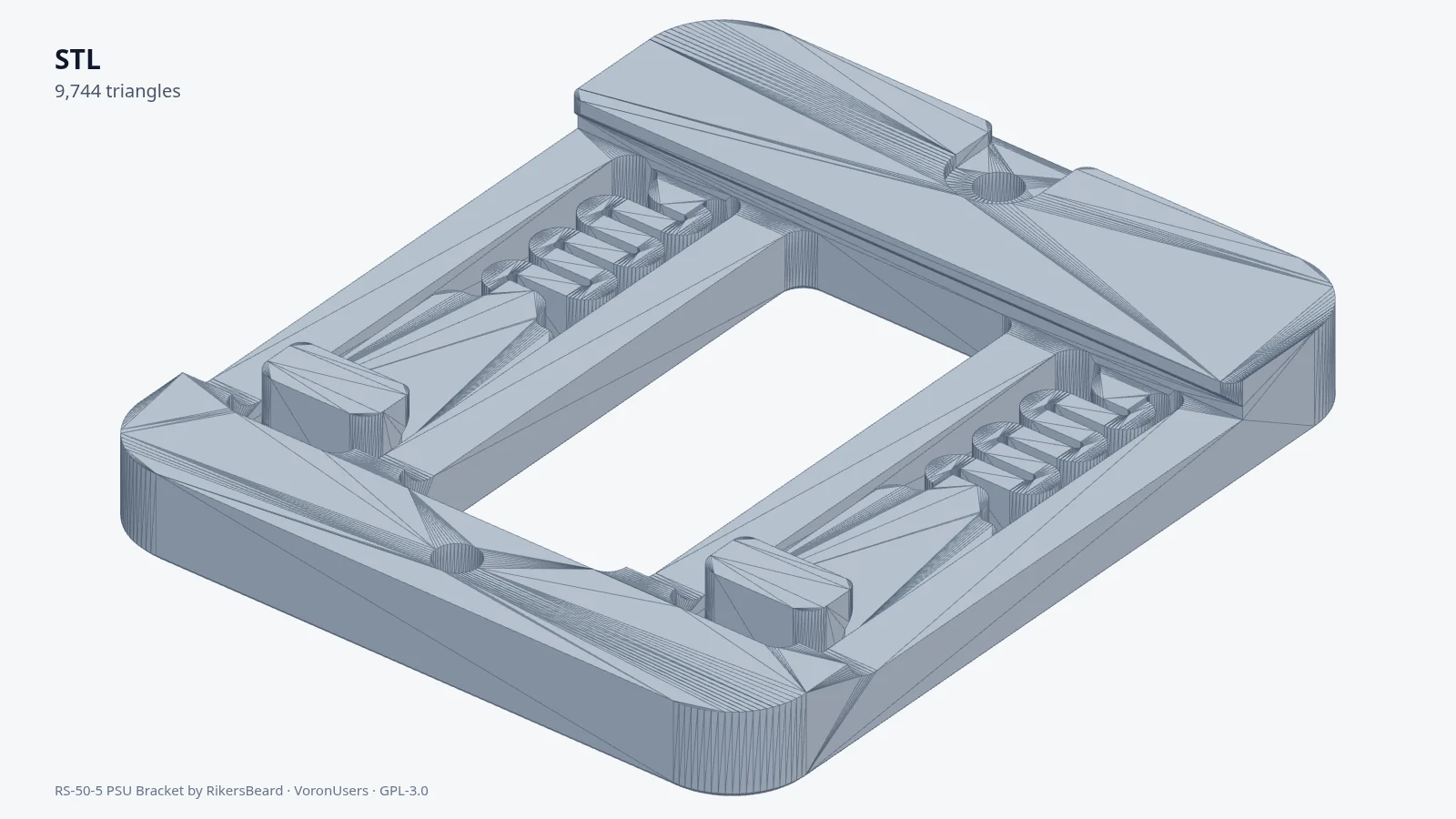
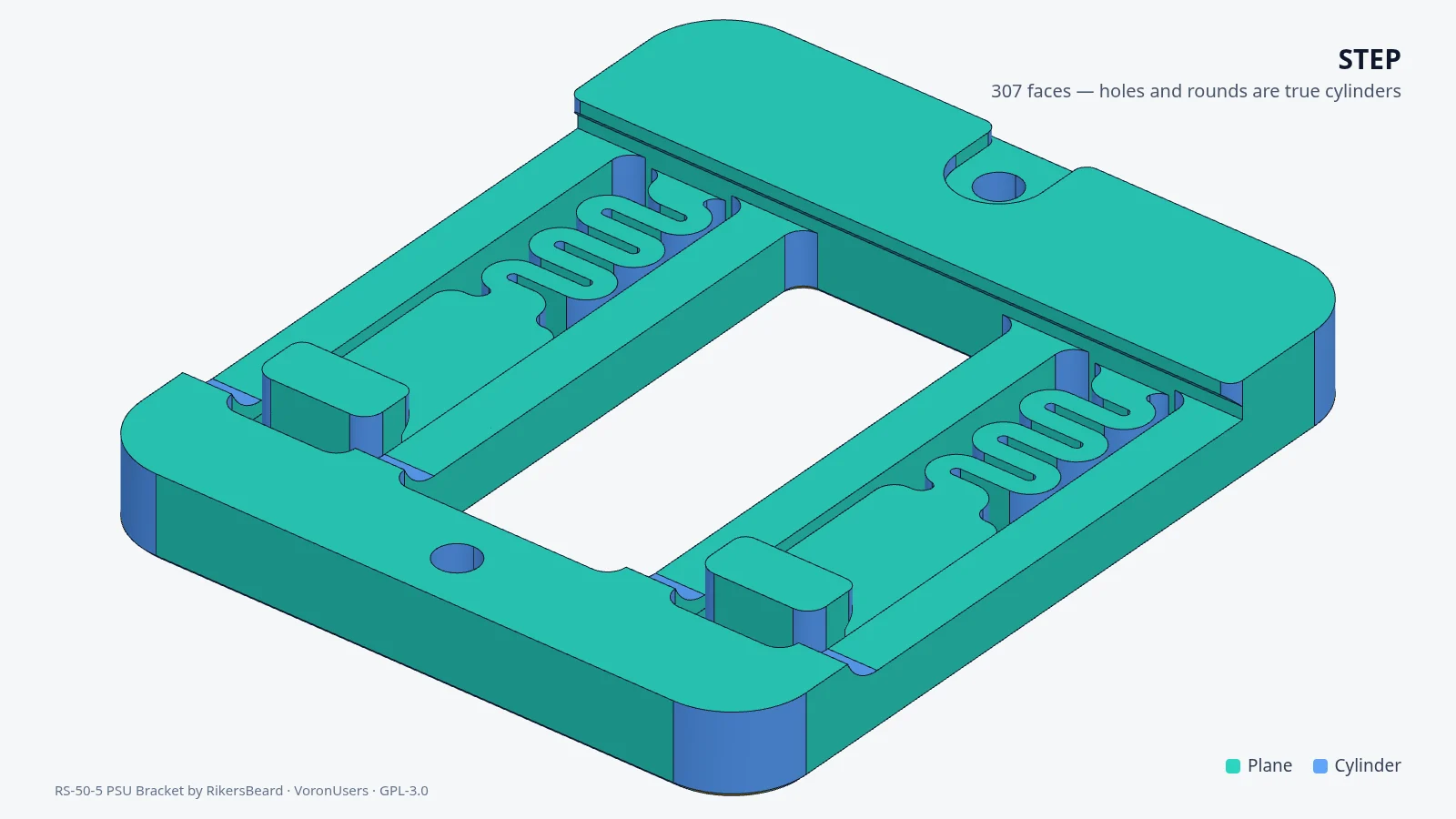
This is one selected part, not a random sample or a success rate; for the overall picture see the historical benchmark. The conversion ran locally in Node with the product’s conversion code, not timed in a browser.
Measured results
| Check | Result |
|---|---|
| Input: the author’s STL | 9,744 triangles |
| Faces in the output STEP | 307 (the author’s STEP: 307) |
| Surface types | 146 planes, 95 cylinders, 66 cones |
| Solid and validity | 1 solid, validity check passed |
| Volume: converted / the author’s STEP | 13,765.332 / 13,765.332 mm³ |
| Compared with the author’s STEP | Judged the same solid: every face matched by type, position and size; boolean difference zero |
How it was checked
Take the author’s STL unchanged from VoronUsers at commit 8e5067f, recognize surfaces with stl2cad WebAssembly, and run the converter’s own STEP read-back checks (solid count, validity, expected volume). Then read the downloadable STEP back and compare it with the author’s STEP: face by face by type, position and size (10 nm tolerance), plus the boolean difference of the two solids. The author’s STEP is used only for this comparison, never given to the converter.
Download and inspect
- Input: the author’s STL476 KB
- Converted STEP502 KB
- The author’s STEP (used only to compare)482 KB
- Source and licence1 KB
Part: RS-50-5 PSU Bracket by RikersBeard, from VoronUsers (GPL-3.0). The converted and edited files are made from this STL and are provided under GPL-3.0 too. The author’s original files ↗
Measurement report and file SHA-256 hashes (JSON) ↓Getting the same solid back does not recover the design history or its parameters. For dimension changes, see what editing a STEP file supports.