
Change a hole size on a part you only have as STL: Ø3.4 to Ø4.5 mm
Measured 2026-11-15
The same Voron bracket as the conversion example. Its two Ø3.4 mm holes are the usual clearance for M3 screws; here they become Ø4.5 mm, for M4. The converted STEP goes through the product’s reconstruction into editable CAD code, and clicking a hole and typing 4.5 makes the change. The result is then checked against the author’s original STEP.
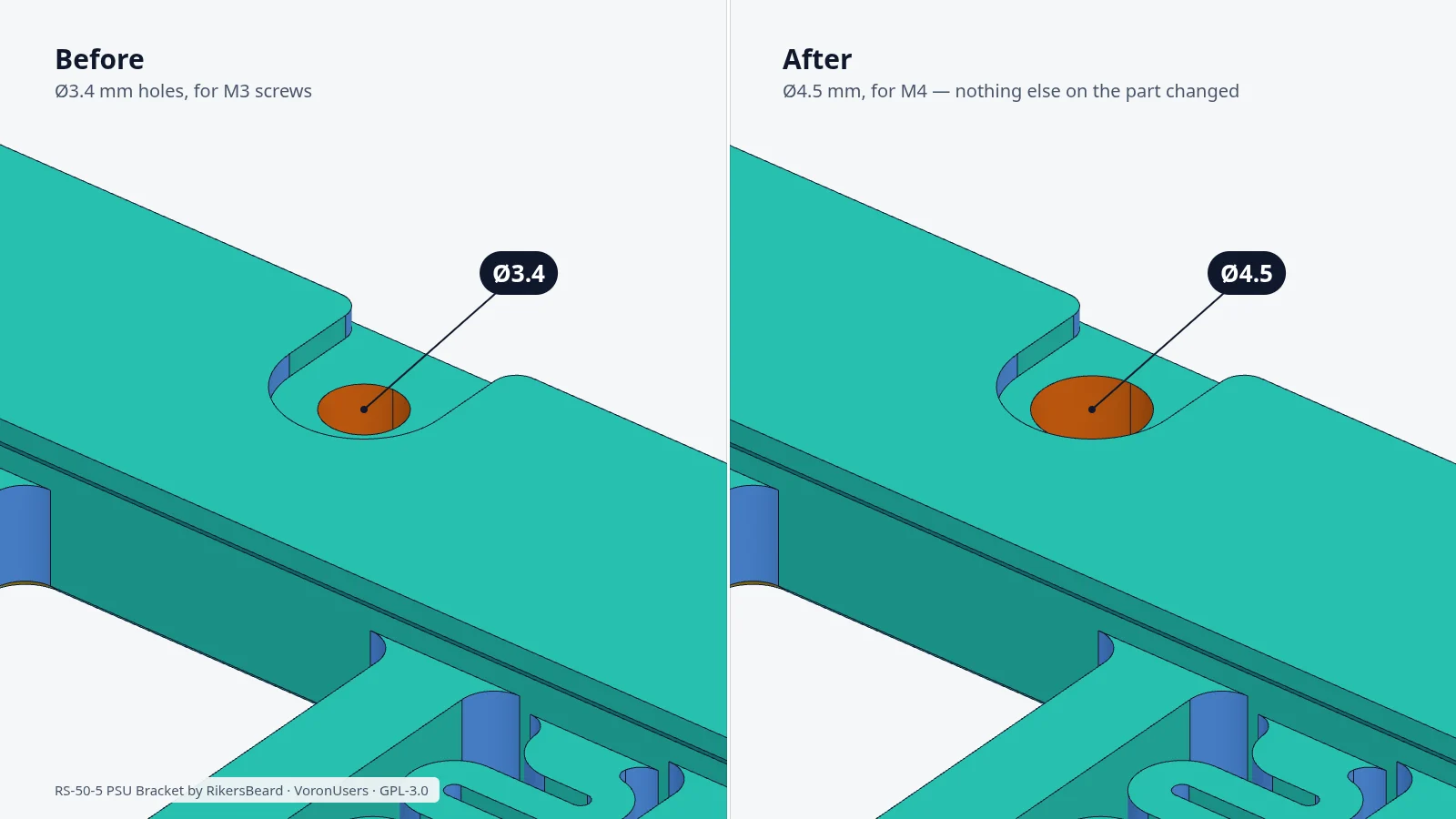
This is one selected part and one edit, not a random sample or a success rate. Conversion, reconstruction and the edit ran locally in Node with the product’s code, not timed in a browser and without the workspace’s sign-in or cloud save.
Measured results
| Check | Result |
|---|---|
| Input | The STEP converted from the author’s STL (9,744 triangles): 307 faces, judged the same solid as the author’s STEP |
| Rebuilt as CAD code | Tier 2: the file’s own solid kept, its holes, thickness and length made editable; the code rebuilds the converted STEP’s solid exactly |
| The edit | Click a hole, type 4.5: the code’s HOLE_D goes from 3.4 to 4.5, for both holes |
| Hole diameters | Ø3.4 → Ø4.5 mm (2 holes) |
| Hole centres, before and after | (0.5, −27.2), (0.5, 27.8) mm |
| Outside dimensions, before and after | 54 × 63.6 × 7.6 mm |
| Volume, before and after | 13,765.332 → 13,674.687 mm³ |
| Compared with the author’s STEP | Nothing added; the 90.644 mm³ removed lies entirely inside the two new holes (their bores and chamfers) |
How it was checked
Start from the conversion example’s STEP (the author’s STL in, the same solid as the author’s STEP out). The product’s STEP reconstruction writes it as model.py: tier 2 keeps the file’s own solid and adds editable steps, and the code rebuilds a solid judged the same as the converted STEP. Then, as in the editor, click one of the two Ø3.4 mm holes and type 4.5: the editor changes the code’s hole-diameter constant and writes it only after the rebuild passes its self-test. Finally the edited solid is compared with the author’s STEP by boolean differences: nothing may be added, and everything removed must lie inside the new holes (their bores and 0.4 mm chamfers). The author’s STEP is never given to reconstruction or editing.
Download and inspect
- Converted STEP (the input here)502 KB
- CAD code rebuilt from it2 KB
- The code after the edit2 KB
- Edited STEP1332 KB
- Edited STL262 KB
- The author’s STEP (used only to compare)482 KB
- The author’s STL (the conversion’s input)476 KB
- Source and licence1 KB
Part: RS-50-5 PSU Bracket by RikersBeard, from VoronUsers (GPL-3.0). The converted and edited files are made from this STL and are provided under GPL-3.0 too. The author’s original files ↗
Measurement report and file SHA-256 hashes (JSON) ↓This edit succeeded on this part; it is not a promise for every part. In the product, importing a STEP into the model workspace requires sign-in and uploads the file; trying edits on the STL converter page happens in the browser, and downloading the changed STEP needs sign-in.